
Virtualism
A metaphysics of the epistemic gap
The question at the heart of metaphysics, of how experience and reality relate, is unresolvable, but the manner in which we frame its unresolvedness matters a great deal. Descartes framed it in dualist terms and attempted to narrow the mystery of the connection between soul and body down to the pineal gland. Chalmers also ended up in dualism, but from a scientific realist starting point, from which he called the question of how to account for consciousness “the hard problem”. I think both philosophers were much too epistemically optimistic. I believe reality as such is in a strict sense unknowable. That the appearance of knowledge or reality access comes from mistaking our virtual constructs for reality. This magic trick of projection and immersion ought to be a central focus of philosophy.
We can’t avoid projecting our perceptions and ideas onto reality, as this is the only way in which we can get oriented and navigate life. If we retreat into a total refusal to make any assumptions, we would incapacitate ourselves, so even skeptics that see through the magic trick need to engage in it. However, one does not have to fully mistake the interface for reality itself in order to use it. In other words, the projection can be interpreted literally or metaphorically. The skeptic rejects the former but must accept the latter.
Literalism is to close the epistemic gap between appearance and reality. This is the mother of mistakes. Literalism misleads and closes us up with regard to how to understand not just reality but ourselves, our minds, what life is and what it can be. Literalism coagulates, fixes ideas in place, makes civilizations as well as people stagnate and break apart from brittleness and contradictions. It makes us unreasonably attached to our limited worldviews, and blind to alternative views. It is closely associated with internal and external strife and suffering.
It is important to maintain the gap, with no exceptions. This is precisely what the empty placeholder concept of the noumenon does in Kant’s epistemology. It is a concept that places reality outside the sphere of experience, in contrast with which experience must be understood as virtual. This is a way to hold the epistemic gap open, to help us guard against the literalist temptation.
Descartes and Chalmers both close the gap, in that they appear to mistake their models for reality itself, without a metaphorical framing. At least at the level of metaphysics, they give in to literalism. Chalmers has it particularly backwards, by stepping into a scientific realist assumption and turning back to puzzle at how to square it with the self-insisting fact of conscious experience. But this subjective experience is what has to be the starting point for philosophy, leaving the true nature of reality as such an unknowable mystery. The real hard problem is of reality – and with that, we find ourselves back in philosophical skepticism.
Kant doesn’t close the gap, but makes a different mistake. He tries to secure a foundation for a workable form of truth by drawing up a universal schema of the necessary conditions of experience. I think this approach is fundamentally misguided. The skeptic has two problems with literalist realism. One is that reality claims trespass across the epistemic gap, and the other is that claims are held to be invulnerable. Kant resolves the former problem by shifting all the weight of his framework to the latter. This is literalism without realism. His supposedly necessary conditions fixate and coagulate just the same. The establishment of the epistemic gap is secondary, almost like a distraction maneuver to appease the skeptics while he tries to reconstruct a static conventional worldview on this side of the gap.
However, the danger of skepticism, which is what motivated Kant to build up his leaning theoretical tower, is not as bad as it’s made out to be. It does leave us with no better standard than provisional trustworthiness, but this does not mean surrendering to a permanent relativistic dizziness, as many seem to assume. It is merely an orientational shift, from being led by a hypnotizing delusion of literal truth, to a more pragmatic method of testing and systematizing, of trial and error.
Kant’s system is an impressive oddity. It is not an intuitive way to think, but a forced workaround, and so it is not something one needs to guard against particularly. It is much more urgent to forcefully counteract our very natural tendency toward closing the epistemic gap. To help maintain this, a minimal metaphysics would be useful. One where the concept of reality is defined as an empty placeholder, just like Kant’s noumenon, rendering experience virtual by contrast. The virtual reality metaphor is so helpful here that the framework should be named after it: Virtualism.
This is a framework that says literal realism is always an error – and that goes for literal realism with regard to itself as well. If we were to understand virtualism to be true in a literal sense, it would implode from self-contradiction, as its postulation of a reality beyond conception is itself unavoidably conceptual. However, this interpretation would be a misunderstanding of virtualism, as it does not position itself as a sole exception to the rule that worldviews can only ever be entered into in the metaphorical realist way. Virtualism can then only be judged on whether or not it is helpful for orientational purposes, which is the most that metaphysics can aspire to be.
Virtualism makes the same move as any metaphysics – it projects a picture and immerses us in it. The difference is that it builds its own provisionality into the picture. It is a model that flags itself as a model, unlike literalist metaphysical frameworks, which forget they are models at all.
We could always take a further deconstructive step toward complete philosophical skepticism, and end up in epistemological solipsism, where we can’t even say whether or not there is a reality beyond experience. But this is an impractical starting point, and dangerously structurally unsound, in that it can easily collapse the epistemic gap and see us ending up in metaphysical solipsism instead. Virtualism is in a sense a reification of the epistemic gap. A story of two disjoint circles, where one represents all that can be experienced, and the other represents reality beyond experience. Holding this picture in mind, at the level of metaphysics, helps maintain the epistemic gap, to avoid falling into literal realism on the one hand and metaphysical solipsism on the other.
The picture of the two circles is itself entirely virtual, but refers outside of itself, essentially by way of metaphor.
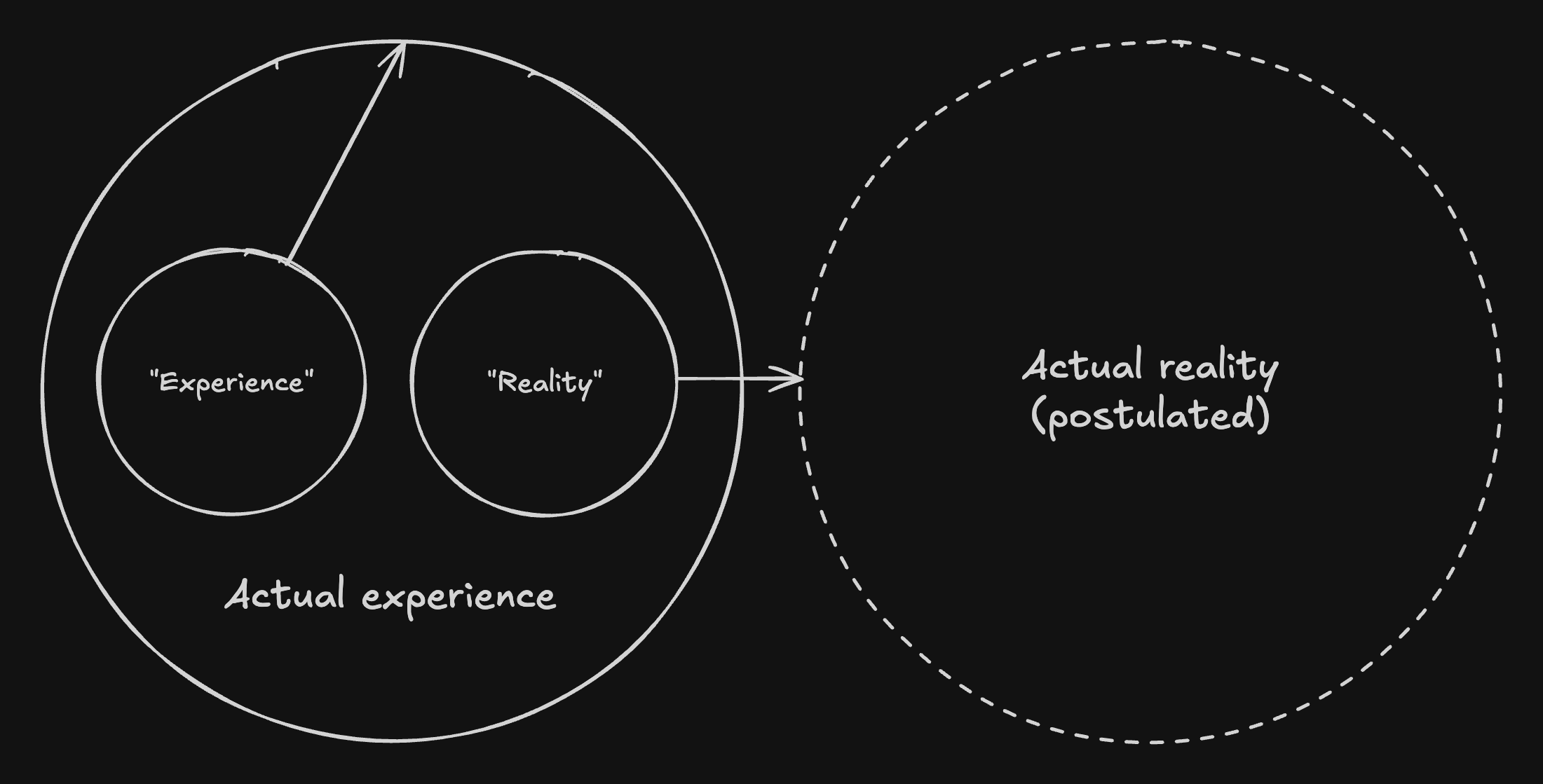
The main motivation behind skepticism and virtualism is to avoid all kinds of literalist delusion, but it also has a surprisingly constructive consequence. When fully accepted, it means even incompatible worldviews can hang side by side, like picture frames in a metaphysical gallery, into which we can choose to immerse ourselves for specific purposes, with virtualist metaphysics as a lifeline we can pull to snap out of it again. Skepticism turns out not to be a dead end where the world is lost, but a portal that opens up to this enchanted gallery where anything is possible again, within frames. In the words of George Santayana, from his remarkable book Scepticism and Animal Faith:
[…] if nothing that appears exists, anything may appear without the labour and expense of existing; and fancy is invited to range innocently—fancies not murdering other fancies as an existence must murder other existences
This ethereal meta-cognitive gallery of worldviews and theories is the proper domain of philosophy, and we can only get there if we snap out of all literal realist immersion. Literalism is the danger, not skepticism. Let’s put virtualism as a metaphysical wedge to hold the epistemic gap open, and start there.